Asteroids as lunar orbit resources
For nearly 9 years, I've had one of my early attempts at a coherent argument for leveraging near earth asteroids in the space program sitting on the right hand side of this blog. I've been meaning to revise that piece for years too (nearby rocks are moving fast and are useful to hit, but not land on), but haven't got around to it.A few weeks back I learned of a NASA study that costed out how to do a major sample and return mission to lunar orbit. It's cheaper than a moon landing. By a lot.
And today I learned about Planetary Resources, which with some billionaire backers is aiming to take on asteroid mining on some scale, according to the WSJ.
For the last 4 years I've been watching the successes of Spacex, Armadillo Aerospace, Bigalow, Xcor, Scaled Composites and others, thinking that they needed payloads, and places worth going to.
Of late, I've been too busy helping fix the internet to pay much attention. I was in Florida for the (scrubbed) 3rd launch of the Falcon 9, and was hoping to be there for the upcoming one, but that's about it.
I'd still, despite admiring those successes, basically given up.
Years ago I'd suggested that Google throw 30m into an Xprize for asteroid exploration. I didn't expect something as big as what Planetary Resources might turn out be. I look forward to more detail Tuesday.
...
Back in the early 90s I tried writing a SF book about the economics and human interactions of what realistic near earth asteroid living would be like, the spectre and the glory of travelling between Jupiter and Venus every four years. I'd hosted one civilisation on the asteroid "Toutatis", in particular. I had fun building the place out with lap pool around the waist, installing plumbing (if you know anything about Toutatis's rotation, this is actually an interesting problem) and observatory, and the stuff that would keep settlers alive and happy for long periods of time, and how cultures would exchange people (much like the American Indians) and knowledge (Usenet!)
I projected 20-30 years of robotic exploration and then a severely modified humanity, to make it out - legs amputated at birth like the dangerous appendages they are - etc. I never finished writing the book, though. Vinge beat me to it with the Usenet hook, dang it.
But: along the way, I proved (to myself at least) that using the NEOs as waystones was the lowest cost/highest payoff starting point for expanding out into the solar system, which has led to countless debates with Mars Society members. I'd steer people at Lewis's "Mining the sky", at Buzz Aldrin's Cycler concept, and at the mass requirements for O'Neil colonies.
I've kept sort of a low level interest in the subject ever since. I always use examples of spacecraft failures in my talks about reliable embedded software design. It's always a good hook with grad students. I keep up on launches, subscribe to several enthusiast lists, read what little literature emerges and sometimes even make it to a conference.
I was a little non-plussed by the recent NASA study for landing people on an asteroid. First up, in my mind, was always robotic exploration and extraction. Still: the costs on that looked pretty good, and I knew mars was more expensive...
If bugged about space stuff, I try to explain that the solar system looks nothing like what Asimov depicted in "Marooned off Vesta". Exploring the rest of it is far more akin to the age of sailing ships that took years to get anywhere, rather than 1g spacecraft that bop from place to place in days, as all the early SF writers mislead us. The economics of sail apply. Except that space is *bent*, in weird ways. The archipelagos move, and the shortest time between two points is never a straight line, and there are keyholes and other interesting gravitational phenomena, and you don't need rockets to get around an asteroid (springs and tethers suffice), etc, etc.
Another big problem has been that most people's impressions of the solar system were formed by the Apollo program and those aforementioned writers - in stories that predate the discovery of thousands of Near Earth Objects in interesting orbits.
Over the years I tried dozens of ways to get the points across, trying to educate people about resonance orbits with Jupiter, proposing a grand tour of the NEOs, and talking about replicating Deep Impact on a grand scale, and various other serious bits like that.
Sometimes I seriously tried to be unserious, in trying to find bridges from everyday experience, to space. I went looking just now for the serious stuff I'd written about Deep Impact and instead stumbled across me channeling Howard Cosell during Deep Impact here, here, and here. Ah, I'd wrapped it around "The Thrilla in the Chilla", indeed. In retrospect I'm pretty sure that I missed both core audiences with those pieces...
I threw a party every four years on Feb 29th, called Asteroid Appreciation Day. Asteroid appreciation day, this year, I moved to 12/12/12 or so (still haven't planned it out)...
I wrote songs about the Challenger and the KT event. The KT event one, "Living in the 00ze", well, I have a much better version of it than this, but haven't bothered to lay it down.
As for the other one... I've played "Rhysling and me - Falling Free and Flying High" more times and in more venues than I can remember - most recently twice a week for over 3 years, live, in front of unknowing tourists, while I was in Nica. I've recorded it with flautista, and in the studio, and a couple other ways, and even wrote a script for the video.
That song got me invited to the Heinlein centennial! Spider Robinson didn't sit in, but what evan and I did went over well - recorded at the Heinlein Centennial. (Evan's song Home went over well too, and I just discovered I still have this enormous archive of all the filksongs played that friday night that I should edit down. Justin Kare, Margaret Middleton...). I also got a chance to meet a bunch of people that I'd only corresponded with, and a few I'd admired from afar.
Not a lot of people know the story of the first sax in space that I reference in the song.
I haven't had much urge to play that song since the last shuttle landed. I'd like to write something happier.
I even tried writing a children's book once, in verse, figuring that having lost this generation, I'd try the next. "Son, your mommy and daddy are both unemployed, and you want to live on an asteroid?" (I still think it was a wonderful story - the kid flits off to dactl and has to be pulled back via tether by his dad - I got a chance to try and explain tethers with a Tom Lehrer/G&S reference - try finding rhymes for centrifugal! )
Every couple of years, I publish links to Lance Benner's work on NEO asteroid rendezvous and intercepts pages. It's my way of keeping up with the rate of discovery.
I was critical of the Dawn Mission on two different occasions because they were focused on big bodies, not small, and of New Horizons, for the length of the mission and the data rate.
While I look on with admiration at Dawn's early mission photos... not having spacecraft, in the space program, with a reasonable cycle time from design to construction to launch to data, from redesign to *mass construction* to launch to more and more data, to enough raw materials for a sustainable ecosystem, frustrates me.
I worry a bit about Apohele NEOs, they are both nearby, frequently, and hard to see. Since discovery, 10 have been confirmed. Apoheles also strike me as an opportunity. I don't know if anyone's calculated intercept or rendezvous orbits for them yet.
My main machine is named cruithne. Backup laptop, ida. My Kindle? dactl.
So like, I dig asteroids. And rockets. And space.
Please note if the above seems excessive - I've just written up what little I'd managed to accomplish in 30+ years of trying, not hard enough, in my spare time. I have no idea if anything I've ever said, did, wrote or sung about space ever succeeded in convincing anybody about anything.
But I'm really happy with the direction the space program is finally going.
All I ever needed was a rocket ship, and the stars to steer her by.
Labels: alt.space, asteroids, space
¶ 1:23 AM 0 comments

Couch surfing and train tour of the US
Well, after an adventure with the survivor TV show, too long to publish now... (briefly - they are filming this year's show near my hometown of San Juan Del Sur, and rented out everything on the beach - including the house I was in!)This was a major interruption in my planning. I was trying to pull together a field test of some new (300Mbit! 5.8Ghz! 12km range!) 802.11n meshed wireless radios - to spread internet and education into Nicaragua before the rainy season. I was running the radios out of that house and had 11 more to install on multiple towers and sites down there (email me if you want a google earth map) and the rainy season started early, and I had to really scramble to get a new house and cope with some other major complications, but eventually...
I rented out a new house in Nicaragua, which wasn't fully ready... so I came back to the USA for the first time in 3 years to visit my friends greg & cherie for their engagement costume party. (pics here and here)
And then I bought a nice used T61 laptop, had the seller slam ubuntu 10.4 LTS on it, AND I bought an Android phone, which works tethered, giving me internet anywhere in the USA.
I completely missed out on two generations of Moore's law. I can, suddenly (from my perspective) call up public transit directions on my phone, and other maps, and take pictures via facebook and upload them immediately, and twitter (I'm http://twitter.com/mtaht over there), and chat, and skype (davetaht), dictate into a recorder, and zillion other things, from anywhere.
After stepping out so abruptly from Nica, I've now realized I could realize a childhood dream of riding the roads, and still get some work done on getting my multiple projects launched... not just the field test in Nicaragua, but maybe, just maybe, get somewhere on getting a real asteroid exploration program going.
I spent most of my life locked in a cubicle! I have seen so little of America, and always wanted to see more, both from ground level and from space. I've got my whole life, including 3 of those radios in my backpack, so I can "war-train" and see what 5.8 ghz spectrum looks like here, too..
So... I've been traveling ever since that party, with stops (so far) in Santa Monica, Santa Cruz, and San Francisco.
The Amtrak train up from LAX to SJC was Amazing, as it cruised over the beaches near Santa Barbara.
Sunday, for Fathers day, I visited with Bill Weinberg, (who I worked with at MontaVista), the Linux pundit, and scored a great interview, advice, and BBQ, with his family.
Last night, at Yoshi's, I met up with Anthony Adams from techweb, and a few other cool people, had some wonderful wine, and then caught the Kronos Quartet. Android almost convinced me... but this concert convinced me, finally, that civilization was worthwhile.
Tonight I'm heading up to visit a relative separated by 4 generations and reconnected by facebook. Monday... I don't know. Maybe back to San Francisco, or Santa Cruz... or LA, or Arizona, or Texas... I have 60GB of audio files to sort through, 2 new records to mix (here's some VERY EARLY sample tracks from one), 5 interviews to clean up and cut down to size, and tons of writing and coding stacked up, and revenue from all that just waiting for me to have the time to do it.
I can do it ALL on a train, now, with stops along the way. It would take months for me just to finish the backlog! I don't really feel like settling down in the US again, yet, AND also want to avoid the monsoon season in Nicaragua, which lasts through November....
I just bought a 15 day travel pass. Almost bought a 30 dayer.
 And if you are anywhere near a train station in the USA and want to say hi, do a meal, talk about IPv6 and/or finishing the internet to the remainder *4/5ths!) of the world, or play some music, or talk about the private space program and/or asteroid exploration, and/or have a spare couch... let me know. Maybe I'll be passing by, soon.
I'm also looking for grad students/surfer dudes and dude-ettes that might be interested in helping me finish getting these radios deployed, using my new house in Nica as a base. And: Linux geeks who would want to work on the cool weather station chipper's been working on in combination with the Guruplug... Free rent... cheap food... GREAT waves http://www.nicaraguasurfreport.com/reportlist.php?id_secc=3&x_date=2010-06-20&z_date=%3D%2C%27%2C%27
My new 12-string (I named her Halcóna) and I have a bunch of new songs to practice, too. In my bag already are "Me and Bobby McGee", "Comfortably Numb", "Wish you were here", Dock of the Bay, "Last dance with Mary Jane", and a half dozen originals. Mauro Caminiti wants me playing bass in Nica with him when I get back, and his setlist is huge, with classics like She caught the katy, and "The joker" left for me to learn.
See you on the Rails!
Labels: asteroids, NEO, points, space, trains, travel
¶ 2:28 PM 2 comments
Video for a manned Near Earth Asteroid exploration mission
By Bruce Damer's digitalspace, who just made boingboing today.¶ 1:09 PM 0 comments

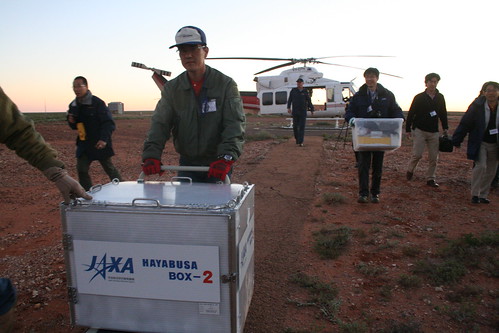
The spectacular recovery of the Hayabusa, and the perfect flight of the falcon 9, I mean, um, wow.
The video server was so jammed up on the falcon 9 launch, that we had 3 separate laptops all trying to get the live video, and ultimately only one with a very bad audio feed in the last seconds before launch.
I hit my recorder to get the last 20 minutes of my reactions on SD card. (It's around here somewhere) The frequent drop-outs added to the tension. I remember rooting for stage separation like some root for the Phillies, and when it happened it was like winning the season, and heading for the playoffs.
Labels: asteroids, space, space10
¶ 10:42 PM 0 comments
A New "Grand Tour" of the Solar System
What would it take to resurrect something like the long-canceled Hera mission, expanded and revised to support a "Grand Tour" of the nearby asteroids and comets? Hera was intended to visit 3 asteroids in the 3-5 years after launch, and then return to earth. The preliminary analysis for that mission (in 2004!) showed 60 possible interesting trajectories and candidates for exploration.The detection of new Near Earth Asteroids (NEOs) continues at a rapid pace, a pace which will increase upon completion of the LSST in 2015. The number of NEOs known has at least doubled, perhaps tripled, since 2003. (cite needed, empirical evidence supplied below)
What I have in mind is a series of small spacecraft, say, 4-12 in number, that would each visit 3 asteroids or comets over a 4-6 year period of life. The tour is only "grand" in that we could explore nearly every known asteroid classification, and would probably be considerably cheaper in current dollars than Voyager 1 and 2 were, particularly if a new launcher like the Falcon 1 or 9 was used.
I haven't the foggiest idea how to generate the enthusiasm for this idea, or the funding, aside from writing about it, and... perhaps... since my stock in trade is as a software engineer, maybe I could work towards making broadly available the software for calculating possible courses (trajectories). Perhaps being able to plot a real course for Cruithne, or tens of thousands of other small bodies, like Sulu from Star Trek, would get more people interested and involved. I know the simulations that Bruce Damer did of the Mars Rover were wildly popular, particularly among youth.
All I really know (thus far) about re-solving this problem is from a chat with one of the scientists involved (items in bold are my open questions, italics is what he told me):
- The trajectory code used for that analysis was JPL's Midas patched conic trajectory tool.(how does a US citizen get access to Midas? The conic section tool appears to be a commercial product from JPL. Is there an alternative? Is it even necessary?) The tool was automated to run 1000's of combinations of solutions. (How? What happened to the code?) These solutions were reduced using impulsive delta-V as a primary FOM. (OK, that's the easy part) The solutions that filtered to the top were then run through a low thrust trajectory code, segment by segment, to generate a end-to-end low thrust trajectory profile. (Solar-Electric propulsion makes a lot of sense, but old fashioned chemical propulsion might be more sustainable for in-situ refueling, being able to simulate a wider variety of spacecraft (included manned ones) would be useful)
Unfortunately it was rather labor intensive process and the work did not continue. Sigh.
It has taken me a long time to get interested in space again, ever since Trailblazer became ashes over the Pacific. What is making me think about it is that orbit@home is now up and running, and there is an amazingly powerful n-body code out there for CUDA , as well. Perhaps this would make it possible to solve a "New Grand Tour" problem for large numbers of asteroid and comet targets using differing types of spacecraft. For all I know, a 200 dollar card with CUDA and suitable software may well be more powerful than the compute clusters used during the development of Hera. (see left for a lovely example simulation of whole galaxies in collision - surely something like that ought to be able to help plot a few courses in our piddly little solar system?)
In terms of delta-v: there are presently 952 good reasons to go to the asteroids rather than the Moon. Some delta-v reasons are almost twice as good than the moon option.
It's also worth repeating the Deep Impact or Don Quijote missions 3756 times by the same criteria....
2 years ago (more accurately, June 25, 2007), in terms of delta-v, there were only 536 good reasons for the asteroids rendezvous and 1920 for flyby missions.
PS: I note that estimated delta-v via shoemakers method is not a particularly good criterion for justifying asteroid missions over Moon and Mars missions, but it may provide a good starting point for a conversation over the resources required to explore the solar system.
PPS: I really don't want to explain delta-v, please see wikipedia for delta-v, interplanetary superhighway, etc....
PPS: I am rather reluctant to use the "Grand Tour" meme (new name suggestions welcomed!), as the original Grand Tour was expensive, and ultimately it was scaled back to the two Voyager missions. Voyager's results were, and continue to be, spectacular. (I really don't like "Grand Tour" as a name - The Grand Tour meme is being reused for the Cassini mission)
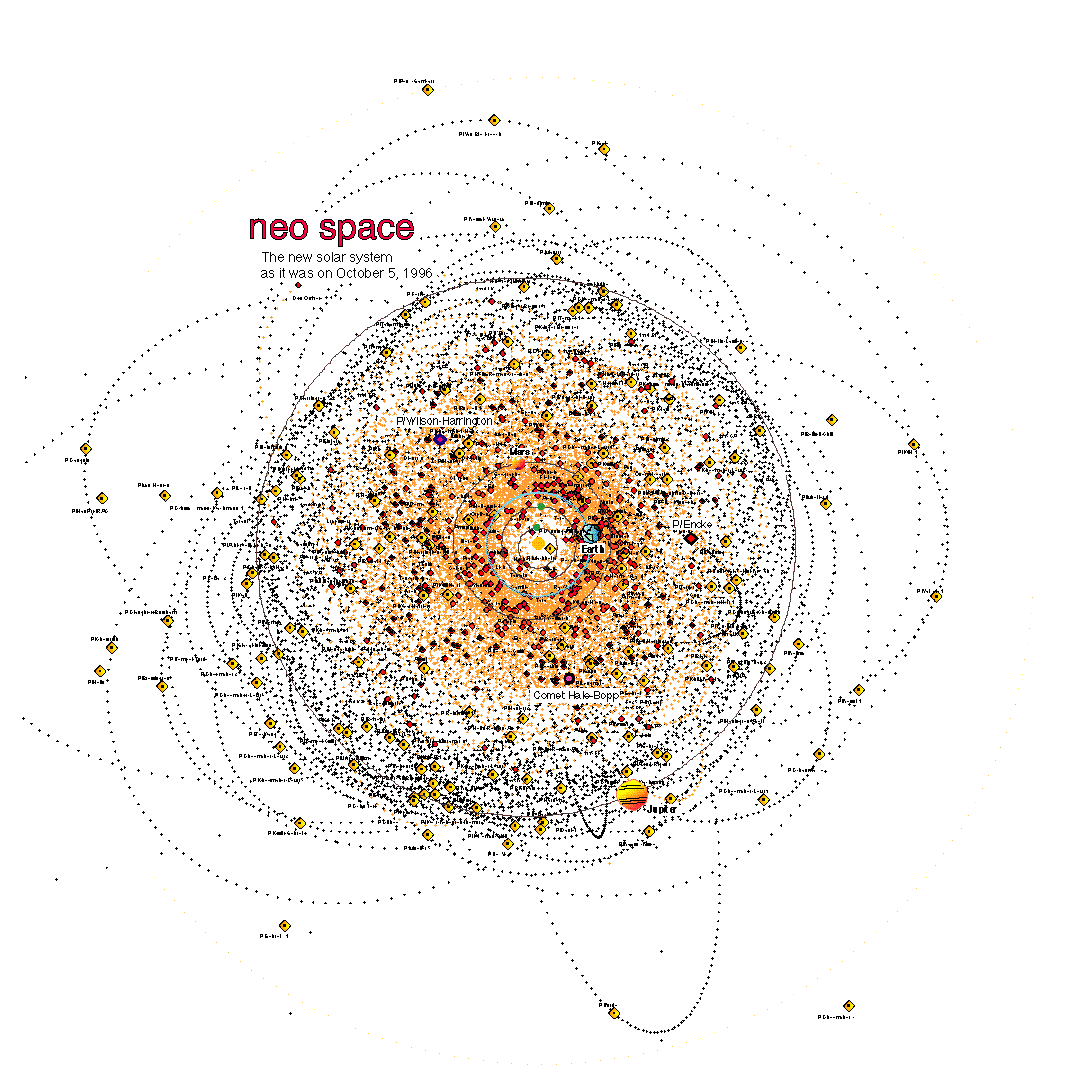
I would really like to see the above chart updated, but given what we know know about the solar system, vs what we knew in 1996, it would be all orange and red inside of Jupiter's orbit, on the scale at which the objects are plotted.
Labels: asteroids, futilitarianism, NEO, space, space09
¶ 4:42 PM 0 comments
Angel Bidinost sat in tonight, channeling all that heavy stuff through her wailing flute, for this version of my song, Falling Free and Flying High. Click on that link to have a listen. I've been closing my set with it on Open Mic nights at Coquitos, the guy that usually plays with me (James Sedgewick, who has some great stuff I will post one of these days) refers to it as "that Rocket Ship song". I don't usually leave space for 3 solos in the song, but I was really digging Angel's flute...
Additionally, for that "Darker side of the rainbow" experience, you can press play on the video above on the "All we ever needed was a rocket ship" line, in the chorus right after the third verse (The one that starts after "Rhysling and me, we watched every launch").Someday I hope to have the tools to do the video to this song properly.
With all the trillions of dollars being thrown around the banking system this month, we could have gone to the moon hundreds of times, and gone beyond.
Labels: asteroids, music, space, space08
¶ 11:43 PM 0 comments
Asteroid strike at 10:46 EST - film at 11!
A very small asteroid (2008 TC3) just hit us as predicted by spaceguard... right over Africa.It was of harmless size (2 meters) but big by meteor standards. Spaceguard is getting gooood.
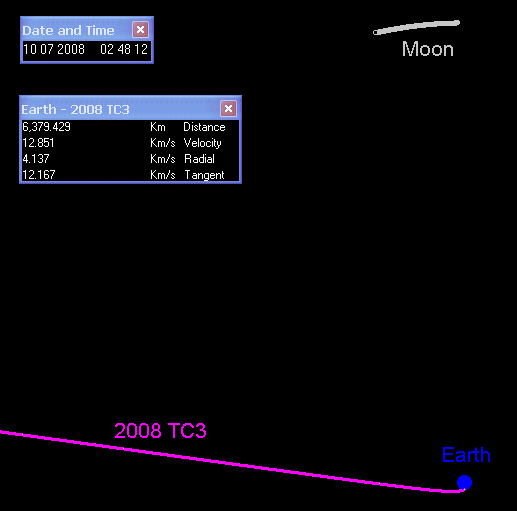
I sure hope some good pictures come from it. Will post as they come in....
Here's a simulated view from the last moments of 2008 TC3:

Update: I had kind of hoped for a picture by now from somewhere, as enough people were alerted... but it's late and I'm tired and going to bed shortly. The key piece of good news in all this was that spaceguard detected and plotted an asteroid on an intercept course for earth for the first time ever. I am really impressed.
The bad news is it was detected only a few hours before projected impact.
Update 2: 2008TC3 broke up somewhere over the Sudan above such a sparsely populated area that it is likely no one got a picture. Here's a 6 minute exposure from before it entered Earth's shadow, courtesy of a very good article about it from the National Planetary Society:
 ¶ 8:03 PM 0 comments
One of the great mysteries of my household in Nicaragua is that periodically, the shower turns on, all by itself. We are not talking a drip here, we are talking about a full bore shower starting up, running for 3-20 minutes, then stopping. When I get there the valve is tightly shut; there's no sign of an invisible man in the shower, dirty or otherwise. I have no idea how much extra water pressure is required to push past the valve, I imagine it is a lot, yet I'm the only one in my building to report this, and there are no waterspouts on the street!?
If I fix it (adding a secondary valve) - will I blow up somebody else's plumbing? It would really suck if the overpressure wave took out someone's toilet. Not suck, actually, blow....
 There are now 5 confirmed asteroids in an Apohele orbit, with 4 more possibles. The delta-v required to reach these is minimal. Atira is 2km in diameter. Nobody knows what it is made of... Perhaps it is the stuff of dreams. It's really hard to spot Apolheles from Earth, I'm surprised we've found as many as 9 so far.
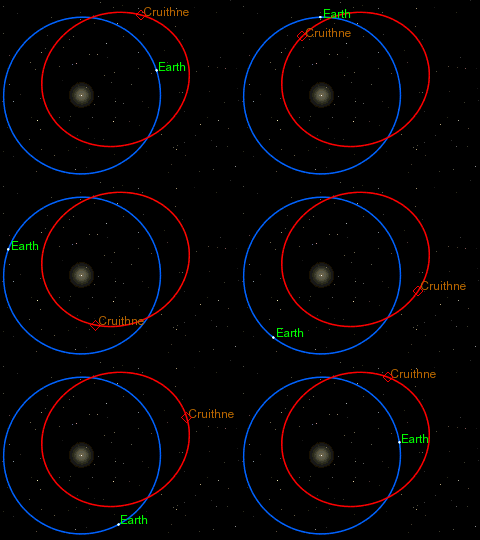 Not technically in a Apohele orbit, but still close by, isCruithne which is a "Periodic inclusion planetoid".
 I wish more people cared about fixing the ocean's decline. Here's a great piece about that in Mother Jones.
I'm still waiting for solar cycle 24 to kick in. In catching up on two of the skeptical-to-AGW sites I track - Watt's up with that, and Solar Science I spotted a familiar name - Joan Feynman - a notable scientist. She came up with a reliable way to predict sunspots (but that web page lacks a cite - I'd like to know what it was - still looking) She started her career in solar physics, was one of the first to describe the magnetosphere and what caused auroras, and her take on the global warming investigation is that it is Great Fun.
I wish more people could take matters of great import less seriously. The Feynmans get it right.
Her son tells a wonderful story on the trials and joys of growing up in her household. Imagine having a mom that knows how to create small explosives for her boy - cool!
I'm more of an engineer than a scientist, so the pleasure of finding things out (great video) is often subverted by the pleasure in blowing things up - maybe I will have to add that secondary valve to my shower this week....
Labels: asteroids, global warming, nicaragua, science, space, sunspots, surfing, tv
¶ 8:28 AM 0 comments
Livin in the 00ze - Asteroid Appreciation Day, 2008
This is a long winded post. Download this new song of mine - Livin in the 00ze, while reading it...I took some heat from my liberal friends regarding my take on Global Cooling. None of them got the "according to slashdot" reference, as if I (or they) should regard much of what they find there to be credible. It's not that I discount the evidence completely, it's just that I am capable of holding two conflicting ideas in my head at the same time.
It bugs me that Global Warming(tm) has achieved the status of religion with Liberals, and Conservatives have had to line up on the other side accordingly, just because the two sides have to fight. It's a scientific set of theories, damnit! There doesn't need to be "faith" involved. Some of the theories I buy into, the rest I remain skeptical about. I'm willing to make plans based on the idea that some or all of it is correct, even suggest cures for the problem, but I think that there are a lot of proven problems that we could be solving, like addressing fishery depletion or curing malaria, rather than laying awake at night worrying about sheep moving back into Greenland, or worrying about your bikini line in January.
I was really annoyed at Al Gore's thermal runaway scenario, where in "An inconvenient truth", he projects a non-linear explosion in global temperatures in the near future by jacking his platform up to the ceiling. I think the same people that made similar projections for the "New Economy" prior to the year 2000 are now all in the global warming business...
Still, all that aside, the thing that bugs me the most is, when I talk to most Global Warming converts, is when I take (my usual) pessimistic approach, and say - "ok, it's true, we're at fault and we're not going stop it in time - what do you do?
What's your backup plan? If we really do hit a global runaway scenario, what are you going to do? What is humanity to do?"
Usually I don't get an answer. (Sometimes I do get some great discussions, though)
I have a whole raft of plans for what I'd do in a global runaway, things like getting used to the heat in Nicaragua, etc - and most people haven't even got that far, their thinking stops at "government must stop global warming", and THAT drives me absolutely nutso.
My backup plan has always been to distrust those that would save the planet, and promote ways to get off it. The earth is one great big asteroid attractor - a target that has been wacked by big asteroids multiple times in history - a great big target. It would be best for our species to get its eggs into multiple baskets, as soon as possible - not only do we have to get out of the way of the next K-T event - but it would also be good to get off-planet to avoid all sorts of other planetary disasters that could befall us - nuclear war, the four horsemen, green goo, takeover by spambots... or google... and Global Warming.
It turns out that asteroids might well be a pretty cool place to live and work, but that's not what Asteroid Appreciation day is about - it's about appreciating what they've done for us. The K-T event killed off the dinosaurs, and gave us mammals a leg up on the planet. Sometimes I think that the various other hits (there was one in Australia 15,000 years ago) also gave humanity a kick in the pants towards civilization... and so, I look up at the sky every February 29th - and say "thanks", and I also shake my fist at the stars - "we'll get out there ourselves one day so we can be safe from you rotten rocks!".
My relationship to asteroids is pretty similar relationship that man has had with his gods throughout history.
There's a lot of other crap that goes through my head on this day, about having to change my retirement plans, etc, but that's the core of it.
I had kind of wanted to spend this year's celebration camping out under unfamiliar stars, in Wolfe Crater but I spent it instead working on my current software project, and also mixing down a song I started years ago, about what life would be left - and like - after an asteroid hit... when the planet would be reduced to supporting only primordial slime and bacteria swimming around grey smoking fumaroles, deep underwater.
The song's called "Living in the 00ze". I started it (and documented the dream that started it) two years ago. Here's a decent mix, though I'm sure I'll hate the vocal in the morning. The raw stuff was recorded over at Nick Mainsbridge's studio with his inhouse drummer and bassist. It was a great session - I'd gone over there to work on two far more troublesome songs, and this one came out in half an hour during a break...
Unlike my usual "mikey winston", neoclassical stuff, Livin in the 00ze is actually drivable and bikeable music. I mixed it on headphones, so I'm deathly afraid that the current (bitchin!) bass part will overdrive car speakers. Let me know.... It should really rock on house or dance speakers, though...
The first feedback I got on the song was: Your CONTENT is more ominous, but I was referring to the mood of the actual music......one of the reasons I think the song works so well is because you have juxtaposed a dark subject with a slightly brighter score and that makes it APPEAR less ominous; whereas PF has an overall ominous tone regardless. I like the slight dissonance, I think it works well with 'Ooze'. It's like you'll get people to sing it because the lyrics and music are catchy, but they will almost be caught off guard upon realizing the content of the song.
Darn it.
I wanted the to be menacing... sarcastic... and ironic... if at all possible. I got closer with this version. I guess I'm almost happy with 'catchy', though....
Now, in my head, there's three overdubs left to do on 00ze, two are of a British or Australian weather announcers, in the beginning of the song there's one coping with global warming, and in the end of the song, there's one describing the weather after an asteroid hit. I haven't done those bits yet. Maybe someone out there can contribute that, my email address is over there on the right.
Here's the lyrics -
Livin in the 00ze
Copyright 2008, Michael David Taht

Drums and Bass kick in

[repeat] Piano Kicks in

[overdub of weather announcer kicks in]

Out in the night
Just out of sight
There's a star overhead
And soon we'll be...

(Chorus)
Livin in the 00ze

Livin in the 00ze
Livin in the 00ze

Out on the beach
Just out of reach
planet bordered in black
It's a Meteor attack

And now we're living in the 00ze
Yes, we're living in the 00ze
Livin in the 00ze

[solos, more overdubs]
Out on the beach
Just out of reach
Mind melting heat
Girls voice: [I just LOVE my peanutbutter and Jellyfish]

[weather announcer]

Yea we're living in the 00ze
and we don't have any shoes
and we're turning corn to booze
Because we're livin in the 00ze.
                           00ze.
To the 800+ known PHA's - Happy Asteroid Appreciation Day - at least one guy loves you. If you have to hit the earth any time soon - aim for Washington.
Labels: asteroids, global warming
¶ 3:30 AM 2 comments
google's CAPCHA broken, global cooling kicks in, and copyright gets taxed
Lots of good stuff from slashdot today. A few years back I mused aloud while rapping to cybernation, that we were trying to make the spambots more intelligent, intelligent enough to read CAPTCHA, for example... Apparently, they are now.I didn't think CAPTCHA would work for as long as it did (and it will be a good while longer before it's routinely broken, I hope). I have spent a bit of time looking into openid, but I trust SSL certs farther, perhaps some progress there will be made soon.
A few weeks back Nick Mainsbridge and I were talking about how google had become the libc or the Linux kernel of the Internet, a monoculture just as bad as Windows, ripe for being exploited by malicious users. I've been getting off of google - partially for this reason - for nearly a year....
I worry, that if we were to adopt strong authentication like RSA certs for blog software, that the bots would start working on that problem too. The race for taking over the planet will be between skynet (google), and the botnets. My money would be on the botnets, if I thought money would have any value after the dust settles from that.
One of my biggest planetary worries, however, is greatly lessened today. It's only a single data point, but it's a big one. Global cooling seems to have kicked in! It is not too late to move to the tropics!
Also on slashdot, the latimes makes an extremely compelling argument for taking intellectual property to the next level, where it can be taxed.
Although treating IP as actual property is a logical extension of current trends, I'd vastly prefer we'd return to pre-1911 copyright law. But I can just see governments drooling over the idea....
Lastly, the planetary society announced the winner of the Apophis competition for an asteroid mission. The cost of the mission is looking to be very, very, cheap. The winning design gets 50 thousand dollars.
I wish google was offering a 30m dollar Xprize to do asteroid missions, not to protect the earth, but to get the hell off it. Call it a backup plan for when the bots win.
Labels: asteroids, bots, copyright, global warming, google, libc, space
¶ 3:19 PM 0 comments
Sometimes I surrender... and something encouraging happens
 And then slashdot - in the space of two weeks - runs 4 * separate * articles on asteroids, and in particular, notes that a group of scientists are actively attempting to reprioritize America's space program away from the moon and Mars and towards the NEOs!?...
- "This is the kind of debate that will go on--beyond whether a lunar base really makes sense. But manned asteroid missions first--ahead of a lunar base--are drawing strong attention," he says. Hubbard and Friedman are co-hosting the event, along with former astronaut Kathy Thornton, associate dean of the University of Virginia's Science, Technology and Society Dept. Thornton flew on four space shuttle missions, including the initial critical repair of the Hubble Space Telescope in 1993.
The alternative vision would also include far greater private-sector incentives for participation at all levels, an area public surveys cite as very important. Missions to asteroids and Lagrangian points, for example, are likely to carry along Bigelow-type commercial inflatable modules. A recent informal space program survey by The New York Times found substantial public frustration about NASA's doing what entrepreneurs could do better.
Under the alternative concepts, astronauts using an upgraded CEV would initially be sent on long-duration missions, not to the Moon, but to land on asteroids where they would sample terrain perhaps more ancient than the Moon's.
I have spent the last couple weeks in Adelaide, South Australia - and later in Melbourne, working A/V for linux.conf.au. Next up - perhaps a visit to Darwin - which seems apropos for Asteroid Appreciation Day.
Labels: asteroids
¶ 1:11 AM 1 comments
Asteroid Appreciation Day, Feb 29th, 2008
For over 20 years now I've had a small memorial celebration, every 4 years, to the asteroid that caused the extinction of the dinosaurs.It always seemed odd to me that we mammals would not celebrate the cosmic event that gave us a leg up on the dinosaurs, always, instead, we quiver in fear of the next strike which might wipe us out. A massive explosion and shockwave covering the world like that one did deserves to be both feared and revered, in my opinion.
Those that worship evolution, rather than creation, would do well to celebrate the rock that gave our species a chance to evolve to its present state.
Why did I chose Feb 29th for this day?
0) There are a bunch of other odd holidays on Feb 29th. I doubted I'm stepping on Sadie Hawkin's toes. We don't know when that asteroid actually hit, anyway... not even to the nearest century.
1) Because Earth's orbit and rotation, while mathematically exact and precise - a year does not always equal a year - a day, Feb 29th, is left over as a reminder that the universe, and solar system, are not perfect and exact according to a human centric view....
2) I'm not really big on giving parties, one every four years is enough.
This year it seems unlikely I'll throw a party at all. Perhaps I'll just find a telescope, and shake my fist at the stars, like I always do. Perhaps some of the past attendies will remember the party and give one of their own...
The last party, in 2004, was a doozy. 3 bands showed up, and a bunch of individual performers played. Captain Crunch crashed it, Allen Lundell went around being profound behind a camera, and the party went on til 5AM...
By the way, I've never been happy with the name I gave this day/party - AAS just happens to be the abbreviation for a scientific organisation that I often get exasperated by...
I do someday hope that the idea for a party like this one would take off... the stars are especially wonderful down under, here in New Zealand.
Labels: asteroids
¶ 11:41 PM 2 comments
3:1 Orbital resonance with jupiter
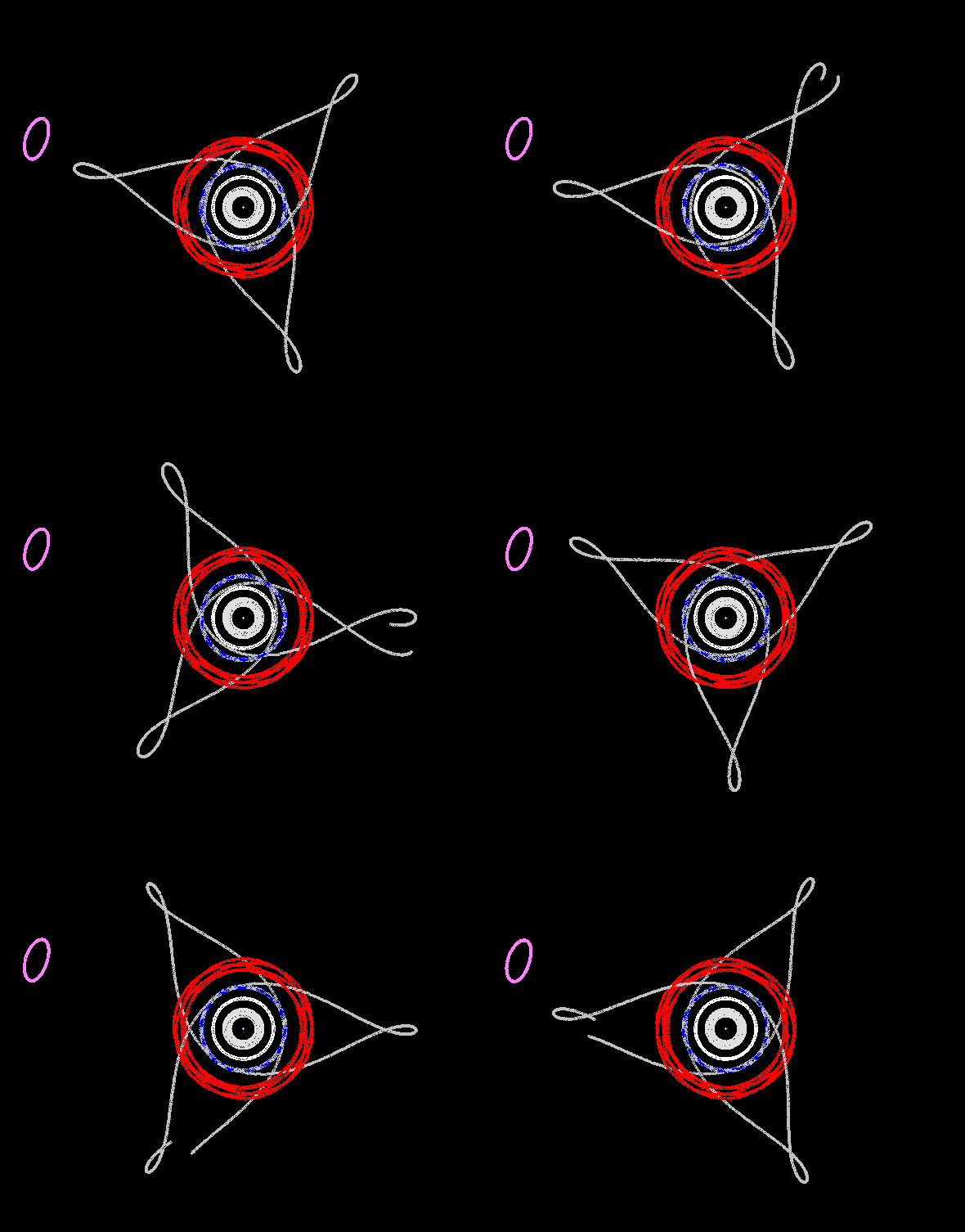 It took a very long time for humanity to realize that the sun was the center of the solar system, not Earth, and still, even then, it's hard for most people to visualize ellipses - and even harder to visualize the effects of other objects in the solar system on each other. I look for visualizations of how orbits and various slingshots really work all the time - things like the Interplanetary superhighway are hard to explain: "What? you mean the best way to get from point A to point B is not a straight line?"
 This animated image is of the 3:1 resonance that the asteroid Toutatis is in with Jupiter, but in a rotating reference frame from a Jovian perspective. (Basically: having the sun be the center of the solar system and holding the relation to Jupiter as steady as possible) Note how the varying pull of Jupiter shifts Toutatis near to Earth's orbit on 4:1 resonance. Basically every four years, hundreds of asteroids like Toutatis make a close approach to earth.
I'm going to make my usual point here, but I'm tired of rewriting it. There are multiple points on a NEO's orbit that make it easier to get to other places in the solar system - with the added benefit of having raw resources to mine and radiation protection for much of the trip.
I looked over Spacex's Falcon 9 plans and saw that they had only published payload numbers to LEO and GTO. I know that alt.space is intensely focused on merely making orbit - but I would love it if they/we could get our heads out of LEO and into L1 - or just, perhaps, a few more lunar diameters. There are a few interesting payloads that only need to get that far.
Labels: alt.space, asteroids, space, toutatis
¶ 8:49 AM 1 comments
The best idea for asteroid threat mitigation
The best idea I've seen yet for financing an independent search for asteroids just went by on slashdot.org.Offer up the mineral rights to discoverers!! From the thread:
- All they really need to do is develop an automated identification software and telescope computer interface. Then sell them for about $200 each. It would only take a 12" scope to ID 99% of the objects!
Then set up a registry and offer the Discovery announcement, naming rights, and mineral rights to anyone that ID's them.
Hell, I would spend all night ID'ing them for the mineral rights alone :)
536 good reasons to go to the asteroids rather than the moon
In terms of delta-v: there are presently 536 good reasons to go to the asteroids rather than the Moon. Some reasons are twice as good than the moon option.It's also worth repeating the Deep Impact or Don Quijote missions 1920 times.
Two more reasons to chase the asteroids rather than the moon:
Asteroid 2004 XP14 passes within .0028906 AU of earth July 3rd. That's almost close enough to smell the wealth in it.
and.. The shuttle takes off July first. Nothing and no-one on board can get their heads out of LEO. ¶ 3:47 PM 0 comments
Pluses: great test of the Atlas V, nice spacecraft, well done mission.
Minuses: Billions spent. Very low data rate. 10 years of planning, years of development, 9 years of mission before the first result comes in, years and years of analysis - of Pluto!! - a rock so distant that we'll not do anything more useful with it for a hundred years - a body that I consider to be just a wayward, very cold asteroid...
While waiting through the launch delays I kept thinking what I could do with an Atlas V and the same amount of fuel - notably - launch 16 identical Near Earth Asteroid explorers - have preliminary results at high data rates back inside of 12 months for each explorer - then go onto another asteroid, and another, and another...
With that one launch, and in less than 5 years, we could do a complete survey of EVERY known asteroid spectral class in our local neighborhood, of asteroids rich in the materials of life (carbon/water) and of commerce and construction (nickel and iron) Instead, we twiddle our thumbs spending 9 years going to asteroid Pluto.
At least NASA didn't have the gall to keep calling the probe "Pluto Express". That piece of marketing claptrap really stuck in my craw. Wake me up in 9 years, I look forward to seeing the pictures of the icy thing.
I note that I'd settle for a couple secondary payloads on cheaper rockets of near earth asteroid explorers. Less risk and cost and more targets that way. But, man, am I jealous of that Atlas V.
Grabbag:
Over at Chair Force Engineer: The Crew Launch Vehicle has run into some problems... Yep. My principal criticism of "the Stick" is simply that we could buy manned launches from the Russians forever without even touching the principal for what it's going to cost to develop a new manned launcher.
Elsewhere - The Europeans are apparently buying into kliper. I don't know what to think about that.
NASA IS doing a lot of things right, COTS for example. I especially love how basic and non-glossy the COTS web site is. To me - that means business.
Lastly, Stardust landed, making the fastest re-entry ever. Another kudo for NASA.
I really, really wish that the parts of NASA I like could be separated from the parts of NASA I don't.
Labels: asteroids, nasa, space
¶ 4:35 AM 0 comments
The falcon (hayabusa) has landed!
JAXA's space probe Hayabusa, after traveling 2 billion kilometers, weathering heavy solar flux, and suffering multiple glitches, including the failure of two of its three reaction wheels, and the loss of its lander, Minerva, has proven an old adage true:If first you don't succeed, try, try again. Harder. According to JAXA, with the help of a communications array based in the US, Hayabusa successfully landed and collected samples of Itokawa on Saturday.
This is an unprecedented technical achievement. My hat is off to Hayabusa's science and engineering team, who successfully - after 4 prior attempts - refined their control software to make Hayabusa be able to land and take off again.
All that is left now is the long return journey back to earth. My prayers go out to this lonely probe to help will it home. Our knowledge of asteroids will be much enhanced thereby. Go Falcon!
Labels: asteroids, hayabusa, jaxa
¶ 12:41 PM 0 comments
And what kind of raw materials would be available on a typical aten? Too hot, and you have no volatiles. Too cold, and cellular metabolisms can't function. Construction of shelter is easy, use an instant shelter, and just add water.... Or adapt a spacehab... you might want to burrow down a dozen meters both for insulation and extra radiation shielding.
The main problem is getting rid of heat in a near vacuum, there would have to be a heat exchanger mounted in the crust. You need one anyway, to boil out various volatiles.
Transport back from an Aten is straightforward - if you use a restartable engine like the Vulcain or the RS-72. Same fuel (NTO/MMH) that took you out takes you in, but this time you end up in Earth orbit with plenty of extra fuel. How much extra fuel typically? Take a wild guess (and comment). (take a look at an Ariane upper stage dry and wet, that should help...)
Wouldn't it be cool if something like a hydrogen-sulfide metabolism could survive on an asteroid?
I've been worrying a bit about the newly discovered class of Aphohele asteroids, which orbit just inside Earth's orbit. While only 2 have been definitively discovered, at least 50 are projected to exist. As they spend most of their time in the Sun's glare, they are very hard for Spaceguard in its present form to spot.
Mean surface temp on 2003 CP20 is a blistering 323K (122F).
Labels: apohele, asteroid, asteroids, aten, space, space05
¶ 11:01 AM 0 comments
A faith based asteroid defense
You know that an issue is getting overhyped when a parody goes by like this one:- The so-called Apophis Amelioration Plan as proposed by DeLay would deflect the asteroid through the use of the two primary tools in the Republican toolbox: lower taxes, and sops to the religious right.
The first prong of the attack would be a 35% tax cut for the wealthiest 1% in the United States. This, according to DeLay, would stimulate industry and investment and "make the time we have left" more agreeable, at least to those who receive the cuts. The cuts would be offset by major reductions in less vital federal services such as Medicaid, environmental protection, food stamps, and asteroid tracking and collision prevention.
The second prong is a raft of new federally-funded "faith-based initiatives" designed to coax Apophis off its collision course with the earth through the power of "prayer, bigotry, intolerance, and positive thinking". Funding for the initiatives will be available to all faith-based organizations that accept Jesus Christ as the One True Lord. Members of other religious affiliations will be involuntarily relocated to the predicted Apophis impact site at no cost.
Labels: asteroids, religion, sarcasm, space, space05
¶ 5:35 PM 0 comments


