Postcards from the Bleeding Edge
Sunday, July 05, 2009
This article is the second (out of four) in replies to Chip's arguments in this blog post of mine, as well as this one. My first reply, attempting to combat some of his futilitarianism, is here. (I miss usenet, it was far more suitable to long, winding conversational threads, but I digress)
Chip wrote:
Chip then wrote:
At the time of Concorde's development, no-one knew the full extent of our oil and gas resources. We still don't, although current surveys appear compelling. We didn't know, when Concorde was started, how efficient such an airliner could be. We couldn't forecast demand accurately, and we didn't know the extent to which sonic booms would inflame the populace against overland crossings. These are some of the direct results of the supersonic experiments. More:
 Concorde pushed Duralumin based construction to its limit. More use of titanium would have helped, but in the 1960s the state of the art in use of that material only existed in the SR-71 Blackbird. Over the past 30+ years the use of titanium, has gone from that very specialized use into laptops, and cars, and a variety of everyday devices, including pens. The upcoming Dreamliner aircraft (as well as SpaceShipOne, Two, and Three) make extensive use of composite materials to further reduce weight and fuel consumption.
When operating Concorde at its design point at Mach 2, it was the world's most efficient jet engine.
The amount of fuel used by all the supersonic aircraft in history is a drop in the bucket compared to our "normal" energy uses.
Concorde travelled, per passenger, 17 miles (27 km) for each imperial gallon of fuel — 17 miles per imperial gallon (17 L/100 km; 14 mpg-US). This efficiency is comparable to a Gulfstream G550 business jet (16 miles per US gallon (15 L/100 km; 19 mpg-imp) per passenger), but much less efficient than a Boeing 747-400 (91 miles per US gallon (2.6 L/100 km; 109 mpg-imp) per passenger).
The Dreamliner is expected to be 20% more efficient than the 747.
Research continues into supersonic flight. Aerion has 3 billion dollars in pre-order sales on it's supersonic business jet.
Discarding an idea because it didn't work the first time is a false efficiency. I believe in constant, incremental change, and experiments to determine future directions for that change.
Research also continues into hypersonic flight, as well as into aircraft that emit a more minimal sonic boom.
[I will have more to write about this later, I am just trying to break a very long email reply into more sane component parts right now]
Chip wrote:
- Things like the Concorde, and its ilk are basically (like today's 'globalism) accidents of cheap non-renewable and polluting energy in the form of oil and coal. Today's standard of living, with all its problems is temporary.
Chip then wrote:
- Non-renewable and polluting energy is remarkably handy stuff, and we've squandered it, and are continuing to squander it. If you are going to use it, then use it if the your life, and the lives of everyone you know and love and care for including the generations yet to come depended you not wasting it. The Concorde was an interesting experiment. But it was also a huge waste of resources, energy and time [bold mine] .
At the time of Concorde's development, no-one knew the full extent of our oil and gas resources. We still don't, although current surveys appear compelling. We didn't know, when Concorde was started, how efficient such an airliner could be. We couldn't forecast demand accurately, and we didn't know the extent to which sonic booms would inflame the populace against overland crossings. These are some of the direct results of the supersonic experiments. More:
Concorde pushed Duralumin based construction to its limit. More use of titanium would have helped, but in the 1960s the state of the art in use of that material only existed in the SR-71 Blackbird. Over the past 30+ years the use of titanium, has gone from that very specialized use into laptops, and cars, and a variety of everyday devices, including pens. The upcoming Dreamliner aircraft (as well as SpaceShipOne, Two, and Three) make extensive use of composite materials to further reduce weight and fuel consumption.When operating Concorde at its design point at Mach 2, it was the world's most efficient jet engine.
The amount of fuel used by all the supersonic aircraft in history is a drop in the bucket compared to our "normal" energy uses.
Concorde travelled, per passenger, 17 miles (27 km) for each imperial gallon of fuel — 17 miles per imperial gallon (17 L/100 km; 14 mpg-US). This efficiency is comparable to a Gulfstream G550 business jet (16 miles per US gallon (15 L/100 km; 19 mpg-imp) per passenger), but much less efficient than a Boeing 747-400 (91 miles per US gallon (2.6 L/100 km; 109 mpg-imp) per passenger).
The Dreamliner is expected to be 20% more efficient than the 747.
Research continues into supersonic flight. Aerion has 3 billion dollars in pre-order sales on it's supersonic business jet.
Discarding an idea because it didn't work the first time is a false efficiency. I believe in constant, incremental change, and experiments to determine future directions for that change.
Research also continues into hypersonic flight, as well as into aircraft that emit a more minimal sonic boom.
[I will have more to write about this later, I am just trying to break a very long email reply into more sane component parts right now]
Labels: futilitarianism
¶ 10:02 AM 2 comments
Saturday, July 04, 2009
Side benefits of the universal information system
- "I foresee a universal information system (UIS), which will give everyone access at any given moment to the contents of any book that has ever been published or any magazine or any fact. The UIS will have individual miniature-computer terminals, central control points for the flood of information, and communication channels incorporating thousands of artificial communications from satellites, cables, and laser lines. Even the partial realization of the UIS will profoundly affect every person, his leisure activities, and his intellectual and artistic development. ...But the true historic role of the UIS will be to break down the barriers to the exchange of information among countries and people." Andre Sakharov (Saturday Review/World, August 24, 1974
I don't think Andrei Sakharov got it entirely right, but man, did the internet come close to fulfilling his prediction!
I keep wondering what was in the ellipsis between "development. ...But the true historic role" - but that information is not on the Internet, yet. Books - at least the ones still covered by copyright, and those long out of print, but still covered by copyright - are only readily accessible via amazon, or not at all.
Babelfish was an early start at breaking down those barriers of language and culture, and google translate is taking that to a whole new level.
New forms of media have arisen, usenet, blogging, twitter, facebook... People can run simulations of the Hubble repair on their desktops, crowdsourcing has become popular where people routinely collaborate, in real time, all around the planet, from richest country to the poorest...
And yet, so many problems are still with us. Do I think they are intractable? No! If I didn't think that we could solve all the problems remaining for humanity, in part, via better technology, I'd be really depressed all the time, instead of just some of the time.
 Most of my last week or three of blogging (A New Grand Tour of the Solar System,Sunday Space grabbag,Big Waves, Bad Knees) have been, indirectly, in response to what Chip commented on a blog post of mine last month.
- By your own words, you either dismiss or outright refuse to read certain works because they are not 'happy'.
I was depressed for days.
Yet, my reaction, my self-trained reaction, of looking for an opposing viewpoint, and exploring the history of the ideas and predictions, finally kicked in... I went and researched Kunzler, and found he'd made specific predictions that turned out to be wrong, so far. It doesn't mean that he's wrong on everything, it just means he isn't God. I completely agree with Kunzler about the core problem - today's civilization relies on cheap energy, and it is running out. His solutions are interesting, and no doubt there are others that both agree with (both of us) and are trying to solve the problem.
So, Chipper - I have a suggestion - go read someone optimistic for some balance, and some optimism, once in a while. I still find Buckminster Fuller comforting...
I have spent the last days being relentlessly optimistic, and arguing with people that I think are making the wrong decisions, or doing the wrong thing over and over again, because of habit.
Yesterday I ran into a lady with a BS in Social work, who was taking a quick two week tour of Central America before returning to America to study for a Masters. Getting more education is a worthy goal, but her reasoning was flawed - there were no jobs for her existing background and school was all she knew how to do. She had no debt but was preparing to take on a lot of it to get her Masters... I strongly encouraged her to continue her wanderjahr, if she could, find something that she loved to do, that paid, and stay out of debt....
Last week I also went and reviewed the current state of the climate change debate, and found no reason to change my opinion that waiting for more data to come in was the right thing. I am especially looking forward to Anthony Watt's report on the effects of bad siting for temperature measurement on the global warming average.
And to balance out the bad news in Honduras...
I read about solar power satellites being funded, and about improving tuna aquaculture, about the accomplishments of legendary engineer Isambard Brunel, and the Age of discovery... and drooled over the upcoming model S all electric sedan, from Tesla Motors. After witnessing 10s of billions of dollars poured down the
And - thanks to the universal information system, predicted, more or less accurately, by Sakharov, in 1974, I was content to believe, once again, that somehow, we'll muddle through.
Labels: futilitarianism, history, internet, oceans, solar power satellites, tesla
¶ 10:24 AM 5 comments
Friday, July 03, 2009
A New "Grand Tour" of the Solar System
What would it take to resurrect something like the long-canceled Hera mission, expanded and revised to support a "Grand Tour" of the nearby asteroids and comets? Hera was intended to visit 3 asteroids in the 3-5 years after launch, and then return to earth. The preliminary analysis for that mission (in 2004!) showed 60 possible interesting trajectories and candidates for exploration.The detection of new Near Earth Asteroids (NEOs) continues at a rapid pace, a pace which will increase upon completion of the LSST in 2015. The number of NEOs known has at least doubled, perhaps tripled, since 2003. (cite needed, empirical evidence supplied below)
What I have in mind is a series of small spacecraft, say, 4-12 in number, that would each visit 3 asteroids or comets over a 4-6 year period of life. The tour is only "grand" in that we could explore nearly every known asteroid classification, and would probably be considerably cheaper in current dollars than Voyager 1 and 2 were, particularly if a new launcher like the Falcon 1 or 9 was used.
I haven't the foggiest idea how to generate the enthusiasm for this idea, or the funding, aside from writing about it, and... perhaps... since my stock in trade is as a software engineer, maybe I could work towards making broadly available the software for calculating possible courses (trajectories). Perhaps being able to plot a real course for Cruithne, or tens of thousands of other small bodies, like Sulu from Star Trek, would get more people interested and involved. I know the simulations that Bruce Damer did of the Mars Rover were wildly popular, particularly among youth.
All I really know (thus far) about re-solving this problem is from a chat with one of the scientists involved (items in bold are my open questions, italics is what he told me):
- The trajectory code used for that analysis was JPL's Midas patched conic trajectory tool.(how does a US citizen get access to Midas? The conic section tool appears to be a commercial product from JPL. Is there an alternative? Is it even necessary?) The tool was automated to run 1000's of combinations of solutions. (How? What happened to the code?) These solutions were reduced using impulsive delta-V as a primary FOM. (OK, that's the easy part) The solutions that filtered to the top were then run through a low thrust trajectory code, segment by segment, to generate a end-to-end low thrust trajectory profile. (Solar-Electric propulsion makes a lot of sense, but old fashioned chemical propulsion might be more sustainable for in-situ refueling, being able to simulate a wider variety of spacecraft (included manned ones) would be useful)
Unfortunately it was rather labor intensive process and the work did not continue. Sigh.
It has taken me a long time to get interested in space again, ever since Trailblazer became ashes over the Pacific. What is making me think about it is that orbit@home is now up and running, and there is an amazingly powerful n-body code out there for CUDA , as well. Perhaps this would make it possible to solve a "New Grand Tour" problem for large numbers of asteroid and comet targets using differing types of spacecraft. For all I know, a 200 dollar card with CUDA and suitable software may well be more powerful than the compute clusters used during the development of Hera. (see left for a lovely example simulation of whole galaxies in collision - surely something like that ought to be able to help plot a few courses in our piddly little solar system?)
In terms of delta-v: there are presently 952 good reasons to go to the asteroids rather than the Moon. Some delta-v reasons are almost twice as good than the moon option.
It's also worth repeating the Deep Impact or Don Quijote missions 3756 times by the same criteria....
2 years ago (more accurately, June 25, 2007), in terms of delta-v, there were only 536 good reasons for the asteroids rendezvous and 1920 for flyby missions.
PS: I note that estimated delta-v via shoemakers method is not a particularly good criterion for justifying asteroid missions over Moon and Mars missions, but it may provide a good starting point for a conversation over the resources required to explore the solar system.
PPS: I really don't want to explain delta-v, please see wikipedia for delta-v, interplanetary superhighway, etc....
PPS: I am rather reluctant to use the "Grand Tour" meme (new name suggestions welcomed!), as the original Grand Tour was expensive, and ultimately it was scaled back to the two Voyager missions. Voyager's results were, and continue to be, spectacular. (I really don't like "Grand Tour" as a name - The Grand Tour meme is being reused for the Cassini mission)
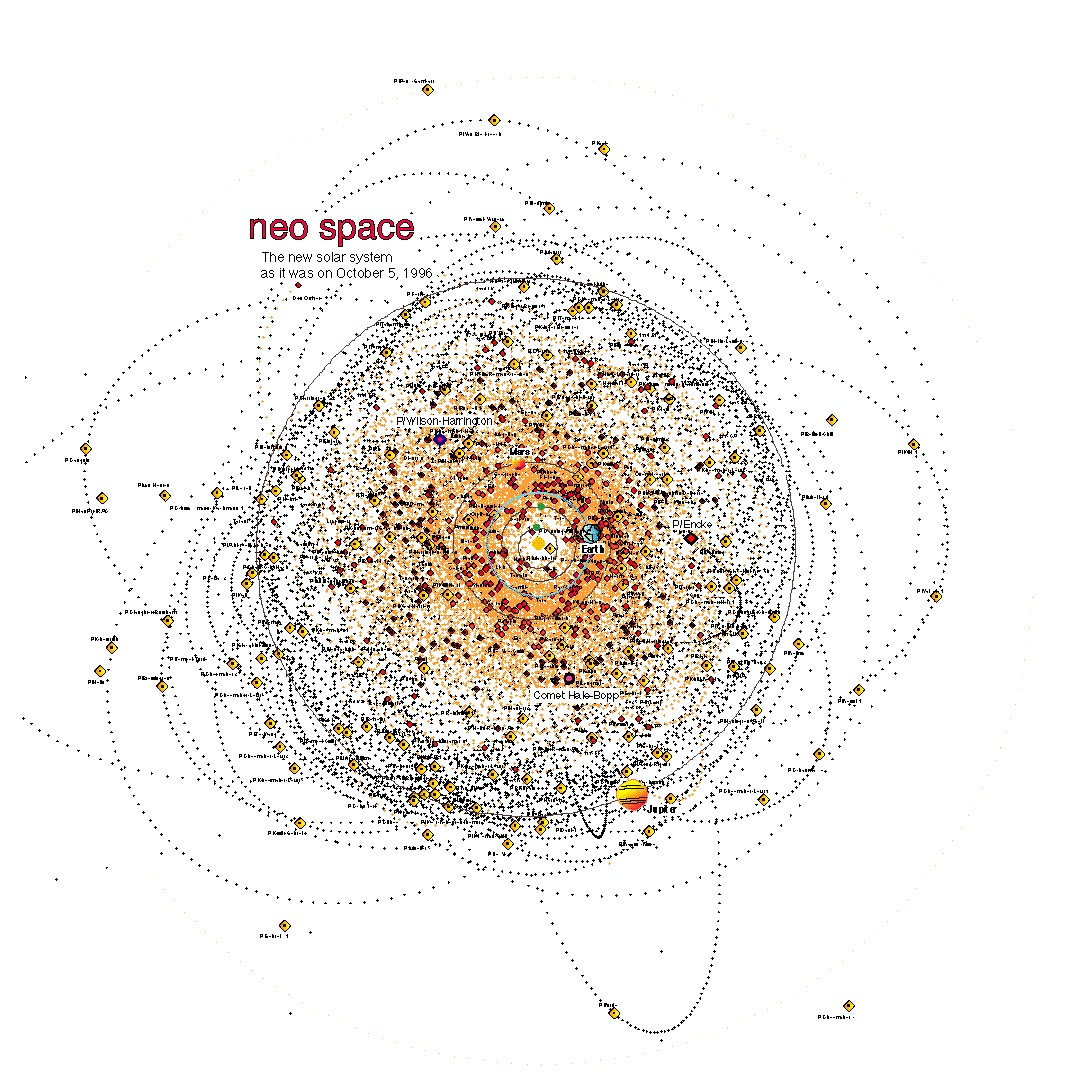
I would really like to see the above chart updated, but given what we know know about the solar system, vs what we knew in 1996, it would be all orange and red inside of Jupiter's orbit, on the scale at which the objects are plotted.
Labels: asteroids, futilitarianism, NEO, space, space09
¶ 4:42 PM 0 comments
Thursday, July 02, 2009
Chipper posts some pictures and writes about his biking to work:
I had intended to get my ebike to SJDS last november. I had big plans on exploring the area and ultimately settling out of town somewhere, to live more harmoniously with nature and get out of touch with my inner geek, and back in shape. Regrettably, the airline I flew out on wouldn't let me take it, so it has sat in my parents garage since then, awaiting my return.
I miss my bike. I felt it would have been a lower-maintenance alternative to a horse and far better exercise, and I would have explored a lot more of my local area than I have been able to explore on foot. Perhaps this year I'll get it... or a horse.
- Most days it adds about 45 minutes to 'bike' (I ride a trike) the last 10 miles vs what it takes to drive. However, when the traffic is particularly abysmal and noxious, I don't know that it takes me any more time at all. Guess why I don't know? I don't know because I am not stuck in it! I have no earthly idea what is going on out there on the roads. As these pics show, this is how I spend that + or - hour that makes up the last leg of my commute.
I had intended to get my ebike to SJDS last november. I had big plans on exploring the area and ultimately settling out of town somewhere, to live more harmoniously with nature and get out of touch with my inner geek, and back in shape. Regrettably, the airline I flew out on wouldn't let me take it, so it has sat in my parents garage since then, awaiting my return.
I miss my bike. I felt it would have been a lower-maintenance alternative to a horse and far better exercise, and I would have explored a lot more of my local area than I have been able to explore on foot. Perhaps this year I'll get it... or a horse.
Labels: biking, futilitarianism
¶ 10:13 AM 0 comments
Monday, June 15, 2009
I have quite a backlog...
I'd like to critique Michael Moore's plan to re-invigorate America, particularly action item 3, where he proposes a bullet train that could cross the USA in only 17 hours. A Ford trimotor crossed America that fast in the late 1920s. Oh, the 1920s! Such a wonderful time that was - the gin flowed, the stock market was up, the world was at peace...
I want to talk to the Republican plan for building 100 nuclear power plants in Obama's green energy bill, as what I wrote last year about Liberty Ships still applies. Also, I note nanosolar has been strangely silent lately.
But, first, I want to work up a spreadsheet of projected energy use, both in the US, and worldwide, first, and overlay Japan's land area over America's to serve as an example, and research the history of the Philadelphia->Atlantic City train as well as Acela. That's going to take some time, and isn't a lot of fun.
 I'd like to talk more to America's perverse safety culture, which I sort of did a month ago, where people are deathly afraid of swine flu and yet unafraid to drive. People ask me about safety where I live now, and I say that nothing compares to the dangers inherent in surfing, yet, I am not going to stop anytime soon - and I counter - at least there's no nuclear weapons pointed at me...
There's been some interesting developments in global warming lately, but I would really rather talk about the state of the oceans. Actually...
I'd rather be writing a book on happier subjects. Or surfing. Or writing a book about "Everything I know (now) about business, I learned from surfing", but the high quality photographic plates required would make it non-publishable and in web format, it would be boring... maybe if I wrote it in "Johnathan Livingston Seagull" fashion it would work... I need a waterproof recorder, all the best stuff I think up vanishes by the time I get to shore....
I also recently found the text to my talk, last year, in Australiaon Living autonomously in an ever more connected world which was one of the bigger things I've written recently and I'd like to bang that into shape for publication, as I went extemporaneous in the talk with a great digression that needs to go back in the text....
I'd also like to talk to "the last great CPU war - ATOM vs ARM" which is beginning now, with arm cortex A8 or A9 processors coming in on the bottom end below Atom and moving up...
But, anyway, if I get around to it, maybe I'll write some or all of the above in the coming weeks. Maybe that last one I could get paid for....
I'd like to critique Michael Moore's plan to re-invigorate America, particularly action item 3, where he proposes a bullet train that could cross the USA in only 17 hours. A Ford trimotor crossed America that fast in the late 1920s. Oh, the 1920s! Such a wonderful time that was - the gin flowed, the stock market was up, the world was at peace...
I want to talk to the Republican plan for building 100 nuclear power plants in Obama's green energy bill, as what I wrote last year about Liberty Ships still applies. Also, I note nanosolar has been strangely silent lately.
But, first, I want to work up a spreadsheet of projected energy use, both in the US, and worldwide, first, and overlay Japan's land area over America's to serve as an example, and research the history of the Philadelphia->Atlantic City train as well as Acela. That's going to take some time, and isn't a lot of fun.
I'd like to talk more to America's perverse safety culture, which I sort of did a month ago, where people are deathly afraid of swine flu and yet unafraid to drive. People ask me about safety where I live now, and I say that nothing compares to the dangers inherent in surfing, yet, I am not going to stop anytime soon - and I counter - at least there's no nuclear weapons pointed at me...There's been some interesting developments in global warming lately, but I would really rather talk about the state of the oceans. Actually...
I'd rather be writing a book on happier subjects. Or surfing. Or writing a book about "Everything I know (now) about business, I learned from surfing", but the high quality photographic plates required would make it non-publishable and in web format, it would be boring... maybe if I wrote it in "Johnathan Livingston Seagull" fashion it would work... I need a waterproof recorder, all the best stuff I think up vanishes by the time I get to shore....
I also recently found the text to my talk, last year, in Australiaon Living autonomously in an ever more connected world which was one of the bigger things I've written recently and I'd like to bang that into shape for publication, as I went extemporaneous in the talk with a great digression that needs to go back in the text....
I'd also like to talk to "the last great CPU war - ATOM vs ARM" which is beginning now, with arm cortex A8 or A9 processors coming in on the bottom end below Atom and moving up...
But, anyway, if I get around to it, maybe I'll write some or all of the above in the coming weeks. Maybe that last one I could get paid for....
Labels: absurdity, disease, energy, environment, futilitarianism
¶ 7:26 AM 9 comments


