And what kind of raw materials would be available on a typical aten? Too hot, and you have no volatiles. Too cold, and cellular metabolisms can't function. Construction of shelter is easy, use an instant shelter, and just add water.... Or adapt a spacehab... you might want to burrow down a dozen meters both for insulation and extra radiation shielding.
The main problem is getting rid of heat in a near vacuum, there would have to be a heat exchanger mounted in the crust. You need one anyway, to boil out various volatiles.
Transport back from an Aten is straightforward - if you use a restartable engine like the Vulcain or the RS-72. Same fuel (NTO/MMH) that took you out takes you in, but this time you end up in Earth orbit with plenty of extra fuel. How much extra fuel typically? Take a wild guess (and comment). (take a look at an Ariane upper stage dry and wet, that should help...)
Wouldn't it be cool if something like a hydrogen-sulfide metabolism could survive on an asteroid?
I've been worrying a bit about the newly discovered class of Aphohele asteroids, which orbit just inside Earth's orbit. While only 2 have been definitively discovered, at least 50 are projected to exist. As they spend most of their time in the Sun's glare, they are very hard for Spaceguard in its present form to spot.
Mean surface temp on 2003 CP20 is a blistering 323K (122F).
Labels: apohele, asteroid, asteroids, aten, space, space05
¶ 11:01 AM 0 comments
A faith based asteroid defense
You know that an issue is getting overhyped when a parody goes by like this one:- The so-called Apophis Amelioration Plan as proposed by DeLay would deflect the asteroid through the use of the two primary tools in the Republican toolbox: lower taxes, and sops to the religious right.
The first prong of the attack would be a 35% tax cut for the wealthiest 1% in the United States. This, according to DeLay, would stimulate industry and investment and "make the time we have left" more agreeable, at least to those who receive the cuts. The cuts would be offset by major reductions in less vital federal services such as Medicaid, environmental protection, food stamps, and asteroid tracking and collision prevention.
The second prong is a raft of new federally-funded "faith-based initiatives" designed to coax Apophis off its collision course with the earth through the power of "prayer, bigotry, intolerance, and positive thinking". Funding for the initiatives will be available to all faith-based organizations that accept Jesus Christ as the One True Lord. Members of other religious affiliations will be involuntarily relocated to the predicted Apophis impact site at no cost.
Labels: asteroids, religion, sarcasm, space, space05
¶ 5:35 PM 0 comments
1) It's using antiquated hardware originally designed as a backup for the Deep Space 1 mission. By the time of launch the basic hardware will be well over 10 years old.
2) It's a 9+ year mission to study two very large differentiated bodies in a realm (the asteroid belt) where SEP (solar electric propulsion) does not work well.
Distant differentiated bodies like Ceres don't interest me. All that means is that the useful materials are buried deep where they can't be easily got at by the primitive mining techniques we have as yet developed. Undifferentiated rocks are possibly of less interest to science, but are far easier to mine.
Far better to launch Dawn towards any of the 3000+ near earth asteroids and comets, where it could survey 1 NEO (more or less) per year in flight, thus giving us a much better overview of the characteristics of the most energetically available off-planet resources.
- Dawn stands down: “Yes…NASA has asked us to stand down,” said Dawn’s principal investigator, Christopher Russell of the University of California, Los Angeles (UCLA). “None of us take this as any indication that they [NASA Headquarters] do not want to launch Dawn,” he told SPACE.com, given “strong words of support” from space agency personnel in Washington, D.C.
Russell said that Dawn is an extremely robust mission. The particular launch opportunity that the spacecraft mission is heading for is extremely long—over a year long, he noted.
I won't cry if Dawn is canceled entirely... but I would jump for joy if someone in congress or NASA got a clue and vectored Dawn towards an M class ("M" meaning metal-bearing) asteroid like Amun or an Apohele like 2003 CP20 or any of a variety of other noteworthy asteroids
Labels: asteroids, dawn mission, space, space05
¶ 2:11 PM 0 comments
 Why? They are innovating in every endeavour of space development they've yet entered - among other things, using Linux in a series of small satellites... and the CEO truly "gets it" about the value of asteroid exploration:
 - You have the main asteroid belt out between Mars and Jupiter, and the minor asteroid belt between Earth and Mars. Scientists believe that there are approximately 100 million objects in the minor asteroid belt. It's known that 25 percent of those are energetically the easiest bodies to get to in the solar system. They're energetically easier to get to than the moon, even though the moon is two and a half days away and the asteroids are weeks and months away. Energy equals money.
Then there's more good news: Scientists believe and hope that approximately 20 percent of those 100 million objects may be dormant comets. That means there may be 20 million deposits of water in orbits around the sun between the earth and Mars. Well, 20 percent of 25 percent of 100 million translates into 5 million deposits of water that are the easiest things to get to in the solar system. Water is hydrogen and oxygen, and that’s rocket fuel.
Decades ago, science-fiction author Robert Heinlein said that when we get to Earth orbit we’re halfway to anywhere. What he meant was that the amount of energy to get us to Earth orbit is equal to the amount of energy needed to get us anywhere else in the solar system from Earth orbit. The problem we have today is that once we get to Earth orbit, our tanks are empty — and it requires a huge effort to get beyond Earth orbit, and that's why very few missions go out into to deep space.
 If you had a railroad tanker car full of water in Earth orbit, that would be 100 tons of water. People recognize that it costs $5,000 to $10,000 per pound to get anything off the surface of the earth into orbit. That means lifting that amount of water into Earth orbit would cost $1 billion to $2 billion. If you were able to send a robotic drill and extraction device to one of the easiest and cheapest of the 5 million deposits of water, and bring back that much water back to Earth orbit, using the water itself as propellant, you'd wind up with an asset in low Earth orbit worth $1 billion to $2 billion.
Now we'd have a filling station. We can refuel our tanks, and we can open up the rest of the solar system. That's the killer app.
More specifically, the killer app is solar thermal water propulsion. That means taking something as simple as mirrors in space — where the solar energy is intense — simply reflecting that intense sunlight onto a little heat exchanger, squirting water from a big bag through the heat exchanger, flashing it to superheated steam out the nozzle in the back, and off you go.
That is what we refer to at SpaceDev as an elegantly simple solution. Elegant simplicity is what's going to open up space, and solar thermal water propulsion is elegantly simple. It goes out and brings back the very substance that is life support in its essence, water. And liquid water is also rocket propulsion.
There are 5 million deposits of water out there, that are the easiest things to get to in the solar system. Why in the world are we looking at deep dark craters at the south pole of the moon that are operating at nearly absolute zero? There's no sunlight down there. There's no energy down there. Even if there's water, it's more like a frost mixed in with frozen dust, sand and gravel. How are you going to mine it, extract it and put it to use? It's ludicrous, especially when we've got 5 million deposits of water that is 50 to 80 percent pure.
...I call dormant comets and water in space "white gold," as opposed to the black gold that allowed the modern industrial society to exist as it does today.
Bonus Link: Some information about hayabusa
Labels: asteroids, hayabusa, jim benson, space, space05
¶ 2:14 PM 0 comments
The broad outlines of the future for manned space exploration
The New Atlantic writes:- In Griffin’s testimony at his Senate confirmation hearing, he made clear his strong support for the new Vision for Space Exploration and candidly criticized the old NASA mentality. “It is time to recognize that we have squandered a once-insurmountable lead in the arts and sciences of spaceflight,” he said. “The best we can say for ourselves today is that our grounded space shuttle is much more sophisticated than the operational vehicles belonging to the two nations which have sent people into space since we have last done so.”
Gradually I've begun to see some coherent arguments around the idea of flying fuel and spacecraft separately on the HLV. The private spaceflight enthusiasists are going ape after the idea, yet not one has seriously suggested that we concentrate on getting resources into earth orbit from elsewhere in the solar system (e.g. NEOs). I guess I'm one of the few who still thinks it would be cheaper to get a grip on space that way.
In this matter, my views are congruent with the fuel depot crowd - if we can separate the propellant from the payload we can double (well, barring drag problems) the usable mass we send to orbit... and perhaps... one day... with this infrastructure in place... we could derive the propellant from outside earth's orbit. The technical problems in transferring cryogenics in space are severe, but they could be mastered - or we could settle on less difficult fuels (methane, alcohol, a variety of others).
Having a viable infrastructure for fuel delivery lowers risk and increases the size of the market for all those interested in seeing more competition in the space industry.
Consider this analogy about gas powered cars: If cars ran on Xenon, and could only refuel in Houston, would they have spread across the US and the world as fast as they did? No! Only by being able to make stops every few hundred miles are cars viable transport.
(Xenon is a popular, but very difficult to refine and rare propellant used in SEP powered spacecraft. It's a dead end fuel, suitable only for missions that can't refuel....)
In looking over the vision for space exploration I note that Zubrin slices NASA's problem in two:
- In the Apollo Mode, business is (or was) conducted as follows: First, a destination for human spaceflight is chosen. Then a plan is developed to achieve this objective. Following this, technologies and designs are developed to implement that plan. These designs are then built and the missions are flown.
The Shuttle Mode operates entirely differently. In this mode, technologies and hardware elements are developed in accord with the wishes of various technical communities. These projects are then justified by arguments that they might prove useful at some time in the future when grand flight projects are initiated.
Contrasting these two approaches, we see that the Apollo Mode is destination-driven, while the Shuttle Mode pretends to be technology-driven, but is actually constituency-driven. In the Apollo Mode, technology development is done for mission-directed reasons. In the Shuttle Mode, projects are undertaken on behalf of various pressure groups pushing their own favorite technologies and then defended using rationales. In the Apollo Mode, the space agency’s efforts are focused and directed. In the Shuttle Mode, NASA’s efforts are random and entropic.
To make this distinction completely clear, a mundane metaphor may be useful. Imagine two couples, each planning to build their own house. The first couple decides what kind of house they want, hires an architect to design it in detail, and then acquires the appropriate materials to build it. That is the Apollo Mode. The second couple polls their neighbors each month for different spare house-parts they would like to sell, and buys them all, hoping eventually to accumulate enough stuff to build a house. When their relatives inquire as to why they are accumulating so much junk, they hire an architect to compose a house design that employs all the knick-knacks they have purchased. The house is never built, but an excuse is generated to justify each purchase, thereby avoiding embarrassment. That is the Shuttle Mode.
I slice it in three - By the time that Apollo was hitting its stride the rot at NASA had already set in. For more details, read Chris Kraft's "Flight". I look to the upcoming moon program and especially the development of a specialized lander and return vehicle as a waste of money - we don't need specialized gear to land on an asteroid - just specialized gear to mine it - and the ability to refuel in orbit...
Labels: asteroids, fuel depots, nasa, space, space05
¶ 9:49 AM 0 comments
NASA should adopt more open source methods. Certainly, publishing on the web EVERY single paper study that they have ever paid for - starting now, but going all the way back to the 50s - would be a huge boon for the public, the engineering, and the science communities, that all want one thing - to be in space - a lot - and cheaply.
Also, publishing on the Net all the source code that controls the rockets would ensure, via Linus's law, that fewer semicolons - and targets - would be missed.
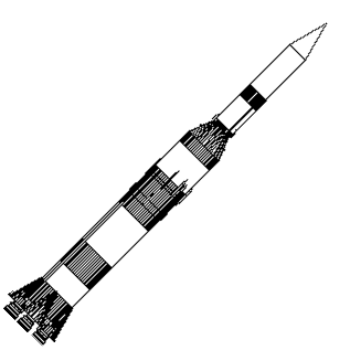 I can't think of a single SF writer who thought that the plan for humans exploring the solar system would look like this:
Starting from the top of the Shuttle replacement's design - I like the return to a capsule. It works. The escape modes are appealing. It can't manuever worth a damn, but who cares.
Yet Europe and Russia are now touting a lifting body based design, called Kliper, which kind of blows my mind. I don't want to think about it. The Russian/Europeans seem to really have some grand plans for spaceflight. Ours is now the more mundane program. OK. I am convinced the current plans for the stick and the heavy lifter will work better than the shuttle ever has - but are the right choices being made?
Michael Griffin outclasses me by 7 degrees, but I can't help but question things like the choice of the 25 year old space shuttle main engines (SSME) for "the stick", rather than the less expensive, 80% lower part count, higher thrust (2.8 MN vs the SSME 1.8MN) RS-68.
Admittedly, as best as I can tell, both the SSME and the RS-68 are being considered for the second stage of the stick, and the RS-68 has had some teething problems.

Secondly, I like the use of a solid first stage but question the use of the existing shuttle part - I've never liked segmented solids and a rocket cast in one piece and floated to Canaveral makes more sense to me.
 It bugs me, a lot, that the Shuttle SRBs are the width they are because that's the maximum width a railroad car could take. Why didn't we build the solid rocket boosters in central florida? Politics.
 The extra segment for the heavy lifter seems like a big risk.
That said, the existing SRBs do already have a manufacturing base, and it costs money to change that.
Thirdly, I wish that NASA had published the technical data and financial analysis behind the choice of developing a new man rated vehicle, rather than man rating something like the Delta V Heavy and closing more of the shuttle production lines.

Proponents of reusables tend to forget - one good way to reduce costs and lower risk over the cost of the program is to manufacture a lot and fly a lot, making incremental improvements. That's why I'm leary of the heavy lifter and the 2 launches per year model. Our heavy lifter program, as proposed, already looks like the B2 bomber program as it ended up.
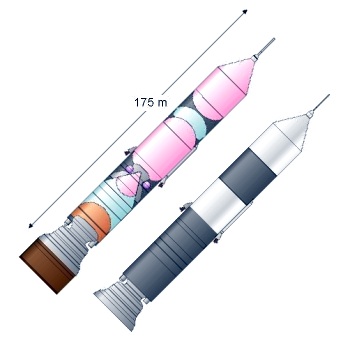
And, if you're going to build a heavy lifter, why not build a REALLY HEAVY LIFTER? I'd like to see, from internal memos, etc, why a design like Sea Dragon isn't feasible.
Still, looking at the two new designs, it's like some politician was given a bunch of parts and asked to re-assemble them without putting anyone on the unemployment line. All that said, it's all back seat carping for now, and damnit, probably, by reusing so many shuttle parts and production lines for both new designs, NASA really is saving time and money.
I'm no longer an advocate for SSTO, reusable vehicles. The staging approach gets the mostest there, fastest - but what are the operational costs beyond that first moon landing using the stick and heavy lifter? No one knows.
If it were up to me I'd outsource the manned program to the Russians and focus on building the heavy using tried and true Saturn V techniques. I'd also seriously think about just putting payloads on existing rockets wherever possible - stop inventing new rockets and just work on the spaceships and the asteroid bases. We're good at spaceships, and haven't tried for the asteroids yet.
I know that there are those who think we should have our own manned program for national prestige. I feel for them. I'd like to have one too. But I want us to fly more missions and more spacecraft far more than I want to waste US time and money in developing new rockets for that purpose. Ramp up the Russian production line for the manned flights.
- Dear NASA:
Please build or buy something this time that you can fly a lot, or let someone else have the job.
Sincerely,
Michael Taht
Selenian Boondocks writes:
- ... for the amount they want to design and field the Stick and the Longfellow, they could buy 60 Delta IVH flights, 150 Atlas V flights, or nearly 540 (!) Falcon IX flights (if those become available). How on earth is NASA going to be cheaper, unless you ignore the $15B development cost and the $3B/year fixed costs?
Labels: ares, google, nasa, space, space05, vse
¶ 6:07 PM 0 comments
meanwhile, 30km out from landing
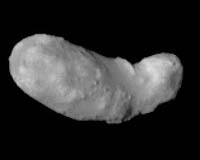 Hayabusa closes in on Itokawa... and to me it looks like a yummy cashew - filmed in black and white.
- The robot Minerva will detach from Hayabusa, land on Itokawa, and survey it while moving around its surface.
Moving around on wheels works only when gravity is present, so a probe with wheels is of no use on Itokawa. Minerva travels by leaping, using its own momentum by accelerating a weight inside itself. This is an entirely new idea.
But it's the first time it's been implemented - and it's a heck of a lot more useful - than the recently announced lunar penguin....
Minerva was the goddess of Wisdom, by the way - and she knew that gravity sucked.
Labels: asteroids, hayabusa, jaxa, space, space05
¶ 11:37 PM 0 comments
I've been in training for today for 3 years or so. It should be easy navigating emailed comments like this from an ex-gf - "So you're 40. Bought a walker yet?" Or Henry Rollins saying "You're aged, you're entering 'Eric Clapton Towntowntowntown'"....
I got up at 4AM to see if the Perseids were showering yet (saw two meteors. It's dark enough where I live, but my house faces the wrong way)
I worked on a song called Saturn's rings, with a sample of what they actually sound like. It needed a bridge. I got part of one, and went back to bed.
I dreamed I was in college again, except that this time I knew how to deal with women.
My first call this morning was from a bill collector.
I got out of bed and as far as the front door to find that my favorite ex-gf had sent sunflowers - that cheered me up enormously. I tried to call her. I got voicemail.
I got my first piece of blog spam yesterday - "Real Singles, at 99 cents a minute".
NASA was kind enough to delay the Mars Reconnaissance Orbiter to this morning (the only candle I wanted to see lit today!), but scrubbed the launch at the last minute. Weighing more than a ton before fueling and more than twice that with its tanks full, MRO is one of the biggest ships ever hurled towards Mars.
The day I was born, in 1965, there were five launches.
I've slowed down a lot, but not as much as NASA.
Second thing I read today - a an asteroid with two moons was just found - one big asteroid "Sylvia": "The density, 1.2 grams per cubic centimeter, is 20 percent higher than the density of water, which suggests it is composed of water, ice and rubble from a primordial asteroid, probably a hydrated carbonaceous chondrite, based on previous spectroscopic studies of the asteroid.
"It could be up to 60 percent empty space," said astronomer Daniel Hestroffer, one of three coauthors from the Institut de Mécanique Céleste et Calculs d'Éphémérides at the Observatoire de Paris."
Tomorrow (friday) the meteor storm should be in full swing and I plan to take my guitar and drums to the beach to urge them on down....
I thought I was just going to shave and go to work in a few moments, as always, my current project is under a heavy deadline, but unexpectedly I have other plans for today. At least I'm shaved...
My boss wrote me: Happy birthday Mike! So you are now both chronologically as well as physically over the hill.
Labels: asteroids, mars, nasa, perseids, space, space05
¶ 10:24 AM 2 comments
Shuttle launch payload constrained by orbital inclination
I get edgy when there's both a hurricane and a shuttle launch brewing. I try hard not to think about all the millions of parts that have to work perfectly to get Discovery and her crew to orbit, carrying 15 tons of equipment for the ISS.I sure wish we'd developed a pilotless version of the shuttle. The Soviets did, with the Buran, but they only flew it once. Now - the city government of Moscow is funding development of their own shuttle!
What's next? Los Angeles funding asteroid missions? New York developing a space traveling garbage barge?
I sure wish our politicians hadn't moved the orbit of the shuttle from one that was good for the US (26 degrees above the equator) to one that was good for Russia. (51.6 degrees above the equator). If ISS's orbit was more suitable we could haul twice the tonnage to the ISS at a time from our launch facilities in Canaveral.
... and if we'd put ISS where we'd intended Space Station Freedom - 29.6 degrees - we wouldn't have had two shuttle tank redesigns and we might not be short one shuttle and 7 crew.
"ISS is russian revenge for spending us broke with SDI" - anonymous Russian engineer
I just looked over a post of the space station budget from 1991, and I just have to sigh.
Who actually won the space race, anyway?
Why do we have to spend billions developing a spaceplane/shuttle replacement to get to LEO when we could just buy the rockets from the Russians and the French - and get on with the important stuff -
building craft to explore the worlds beyond earth orbit.
Labels: asteroids, gto, iss, nasa, orbits, solar system, space, space05, spacecraft
¶ 4:51 PM 0 comments
Also spent some time reading over a blog from the JPL center. The "Whipple Shield". Heh. The coverage keeps getting better.
I always wanted to live on a comet, or asteroid. Sure, I may write a lot about the commercial value of mining NEOs, and complain a lot about the costs of manned exploration, but it's only because we need robotic missions to pave the way for humans in space.
I long ago gave up any hope for me actually getting to space - I'm overweight, underqualified, and just generally a bad choice - but I do ferverently hope that some day, before I die, mankind will have moved into the solar system in a big way.
I think this is going to be my desktop background screen for a while:

Labels: asteroids, deep impact, robotics, rockets, space, space05
¶ 8:22 PM 0 comments
Nubile Projectile vs The Penetrator
 "Right now we're minus one spacecraft," said Rick Grammier, Deep Impackt project manager at JPL. "It's been totally vaporized... as planned."
At last our knowledge of comets is more than skin deep. In a split seconds the Penetrator blasted off the Nubile Projectile's clothes, revealing what space weathering had obscured. She ain't pretty (but a billion years will do that to a gal), but now we know a bit more about her history than we could learn by passively watching a telescope... I wonder about the little jet on the right of the first picture - secondary explosion or a previously existing jet? A photographic artifact? Still the point to doing more! impactor based missions is that, as scientists put it:
- we still do not understand the physics of space weathering well enough to [italics mine]confidently assay mineralogy of diverse asteroids by remote-sensing...
For the last decade it's been "fear the stranger, hate the stranger" - now some think we're at "kill the stranger" stage - but to me, this little bump in the sky at 23000 mph was filled with love. No-one was hurt in this smashup that didn't know what they were getting into...
 Of course, the ultimate collision didn't quite live up to artistic expectations, but it did turn out that Tempel 1 was a great deal more firm than previously believed. If it weren't for their long periods, comets may turn out to be a great place for men to live.
Some wonder if Deep Impact has
anti-ballistic missile applications? Of course it does. Clementine-2 - the first designed impactor mission - was canceled in '93 because of it's association with SDI.
 The problem is: hitting objects at long distances is a useful skill to have - whether you're a baseball player, or a nation worried about national defense, or a frustrated engineer that wants to know - quickly and cheaply - just what M and S class asteroids are made of. Still my favorite twinned body is Toutatis, shown here, passing by only a few lunar distances away last september.
 I'm not the only one reaching for sexual analogies - the new scotsman calls this The big prang theory...
Labels: comets, deep impact, humor, space, space sports, space05
¶ 10:32 AM 0 comments
the Nubile Projectile gets no respect
What the heck is Deep Impact, anyway?National Geographic:
- Scientists, who know very little about the interior of comets, hope the trash can-size projectile will smash a hole deep enough in the comet's icy exterior to reveal what lies inside it.
No, actually - It's a table, and a washing machine!.
JPL calls Deep Impact an "Impactor" - which is about as sexless a term that NASA could come up with, which much have been chosen with great deliberation and forethought.
So, anyway, as Deep Impact is a washer, a dryer, a trashcan, a table, and an impactor, I know what it is now.
it's absolutely everything a 50s woman could use in space.
It's a washing machine:
Great. And what 2050s woman would want to do laundry? Let's hurl our appliances at the stars. What if we actually did start - purposefully - flinging our malfunctioning gear to immolate itself against various comets, asteroids, and worlds?
- "Little Magee Mae, of Chicago, Illinois, smashed her 1975 gremlin against Phobos today, to great scientific result and satisfaction. Magee, who is a grandmother of 3, clapped her hands and twirled with glee. 'That'll teach that old stinker', she said. 'I been afraid to drive that for 65 years'."
"Bill Smith, of East Clinton, Texas, hit Toutatis with his Xbox 780 today. 'It made a better explosion in space than it ever did on the TV', he said."
"A group of internet enthusasists coated asteroid MN2004 today with a full spread of AOL subscription CDs. They note that the dramatic increase in reflectivity will help in tracking it when it passes by again in 2029. Some scientists expressed concerns about the Yorp Effect, but a spokesman for the group, tapping lightly against a map of Washington, said 'oh, no - we calculated for that precisely...'"
And 625,000 names on a mini-cd are getting smashed against it:
- We don’t know what level of satisfaction the 625,000 will get knowing their name is going to be vapourised in space hitting a traditional symbol of woe and misfortune. However it is nice to know that they are involved in the highest smashing of a record ever recorded. Now why didn’t they include some Boyzone singles and some Bulgarian Popfolk while they were at it?
After the spectrographic analysis is performed (I have to stop reading these NASA press releases, it's making me overuse passive voice!), we'll be able to calculate the comet's value on earth, in dollars. It's liable to be a big number - but an even simpler number, if we could use the cometary materials IN space (in-situ), is easy to calculate. Launch costs from earth are well over 100,000.00 $/lb, and estimates for the comet's mass range from .1x10
Comet Tempel 1 worth 2.2 million trillion dollars in earth orbit!
Now look. That's a really big number. It's hard to cope with.
I wish it was possible to do a fantasy plot of this asset vs google's assets on some fictional stock exchange, and I remember how hard people tried to open new routes to India, Japan and the Americas.
It's easy to repeat this mission for other objects that are equally interesting - and closer. I am so tired about endless talk of defending against asteroids and never talk about using them. I'd go on - by I have written about it too many times before.
Labels: comets, deep impact, humor, space, space sports, space05
¶ 2:50 PM 0 comments
The Thrilla in the Chilla
"In this orbit, weighing in at Several Billion Tons, the great Comet, the Nubile Projectile, Tempel 1!, "
[audience hisses, roars]
"And in this orbit, the challenger: built by the most kick ass country on earth, and weighing in at eight hundred and twenty pounds: The Penetrator!
[audience roars]
They're Closing in at twenty three thousand miles an hour! What will happen when they meet?
Three reasons:
1) It's cheap, as such things go - only 333m/dollars - and much of that was spent on hardware that could be mass manufactured and used as a standard technique to figure out the true composition of the 1200+ near earth asteroids, dropping the cost per asteroid explored down below 20m/per.
The cost of today's space missions can be divided, nearly equally, into three parts - the cost of the hardware development, the cost of the launch itself, and the costs of creating and later maintaining the mission. Due to inexorable political factors, these costs tend to be roughly equal in modern probe design - and in (in the case of the jupiter/pluto lobby), oftentimes the hardware development and maintaining the mission far outweigh the launch costs.
Many proposed space missions seem to be nothing more than jobs programs for the people that design (and redesign) them - and I can't even bear to publish the costs of running Dawn for example, or the ludicrously misnamed 17 year+ (30 years, if you included the design stage) "pluto express" mission...
The mission duration of Deep Impact is only 6 months.
I favor a pull-back from the edges of the solar system in order to focus on finding and then utilizing resources that could give us a better springboard to further exploration. More launches would lower launch costs. A shorter mission duration maximizes the gain of information and minimizes the cost of operation. Using impacts, rather than passive sensing, results in fast in-depth spectrographic results from a variety of sources (the big scopes - Hubble, Spitzer and Chandra will be watching) that we'd otherwise spend months teasing out of the system... and standardized hardware equals lower production costs.
Mining asteroids and comets to provide materials for future exploration should be a no brainer - it's not as if greenpeace was floating around the solar system in little rubber spaceships, or as if spending 100k/lb to haul things up from earth made any sense...
2) The results of Deep Impact promise to be spectacular. I'm far more an engineer than a scientist - blowing things up to learn about them is direct, and almost 2nd nature to me.
3) I like to think that a more frequent pace of exploration would get us a better story about these objects than the interminable - "Asteroid XXYY to not destroy earth" articles. Heck I'd like to see more betting pools spring up... see space news covered on the sporting pages... and, hey, why couldn't they hire a sportswriter or two to add some friggen excitement to the event?
- Stay tuned until 1.50AM July 4th for the Thrilla in the Chilla!Beeee Theree
Labels: comets, impactors, space, space sports, space05
¶ 6:52 PM 0 comments


